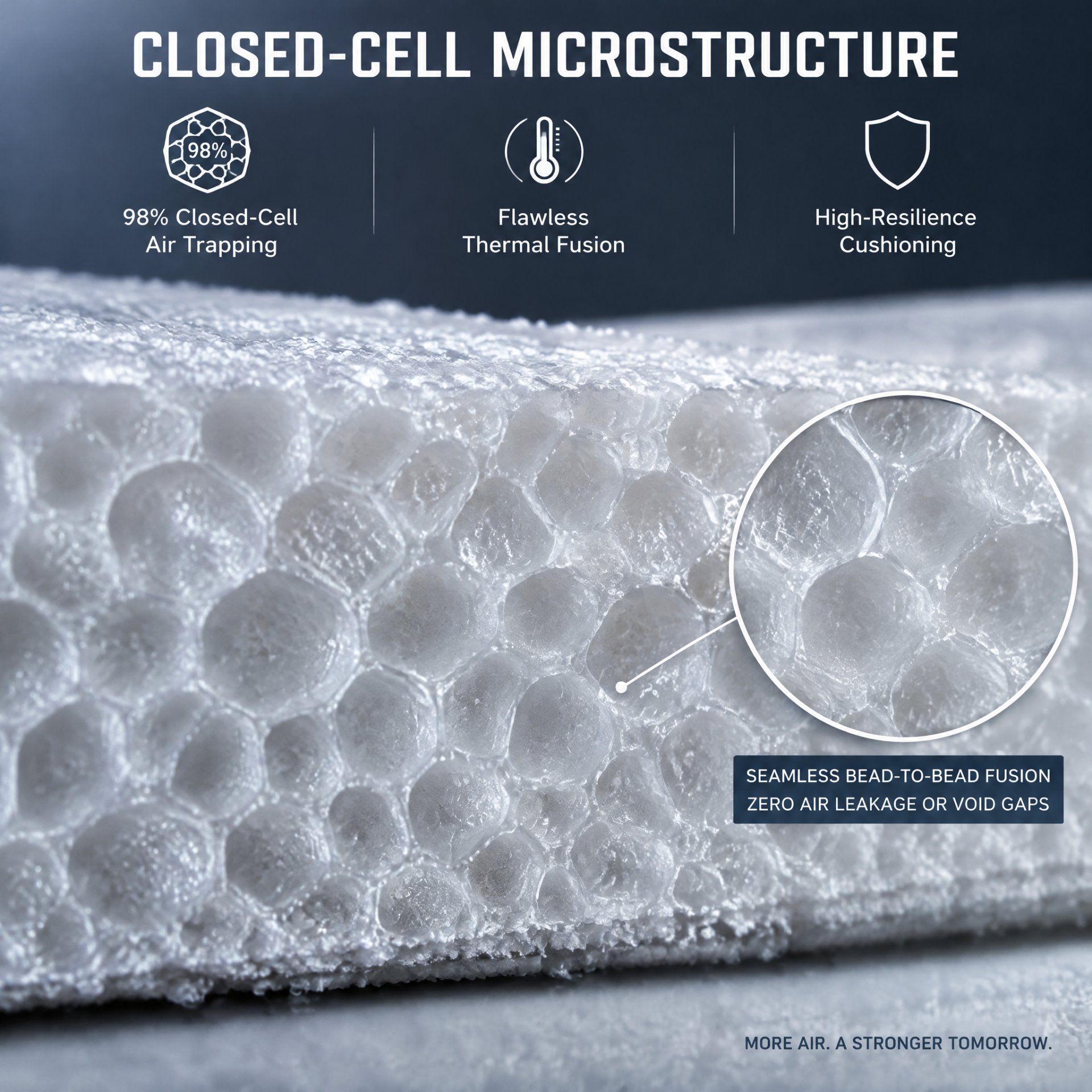
Specifications
Bead Size & Expansion Ratio Table
Choose the bead size (particle) that matches your target density. Values are typical expansion ratios (×).
| Spec | Avg. bead size (mm) | FL | F | FM | FG | E | B | H |
|---|---|---|---|---|---|---|---|---|
| MS | 1.2 – 1.8 | 60–70 | 70–85 | 60–70 | 60–70 | 70–85 | 60–70 | 75–85 |
| SA | 0.9 – 1.4 | 50–60 | 60–70 | 50–60 | 50–60 | 60–70 | 50–60 | 65–75 |
| SB | 0.7 – 1.1 | 40–55 | 50–65 | 40–55 | 40–55 | 50–65 | 40–55 | 55–65 |
| S | 0.5 – 0.9 | 30–45 | 35–50 | 30–45 | 30–45 | 35–50 | 30–45 | 40–55 |
| 4S | 0.3 – 0.6 | 20–30 | 20–35 | 20–30 | 20–30 | 20–35 | 20–30 | 25–40 |
Larger beads reach higher expansion (lower density); smaller beads give finer surface detail for thin-wall packaging.
| Physical & Chemical Properties (typical) | |
|---|---|
| Appearance | Translucent / milky white round beads |
| Bead size range | 0.25 – 2.5 mm |
| Specific gravity | 1.03 |
| Bulk density | approx. 610 kg/m³ |
| Softening point | 70 – 85 °C |
| Moisture content | ≤ 0.5% |
| Residual styrene | ≤ 0.3% |
| Screening efficiency | ≥ 90% (QB/T 4009-2010) |